
How to Prepare Your Florida Condo Association's Budget: A Step-by-Step Guide for Treasurers
A practical walk-through for volunteer treasurers, using a fictional 60-unit building from our free Condo Budget Template as the example.

Table of Contents
- Introduction
- Gather the paperwork first
- Start from what you are actually spending
- Work through the expenses line by line
- Be conservative with other income
- Enter the reserve contributions
- Let the assessments come out of the numbers
- Check it before it goes to the board
- Frequently asked questions
- A good budget starts with reliable financial records
- Try it on your own budget
1. Introduction
Preparing your Florida condominium association’s annual budget doesn’t have to start with a blank spreadsheet. Whether you’re a volunteer treasurer preparing your first budget or a board member reviewing next year’s assessments, the process starts with the same information: what you budgeted this year, what you’re actually spending, and what will change next year.
This guide walks through the process using Sample Shores Condominium, a fictional 60-unit building that is the worked example in our free Condo Budget Template, built for Florida condominium associations. If your records are up to date and your reserve figures are settled, a first draft is often an evening’s work.
2. Gather the paperwork first
Before any numbers go in, collect:
- This year’s adopted budget.
- Actual income and expenses to date, from a year-to-date income statement from your bookkeeper or manager.
- Your reserve study, including Florida’s structural integrity reserve study (SIRS) if your building needs one.
- Insurance renewal quotes or estimates from your agent.
- Service contracts, with next year’s prices.
- Notices of utility rate changes.
Most of the questions that hold up a budget are answered by one of these documents. Ask for the insurance figures early: for most Florida associations, insurance is the largest line in the budget.
3. Start from what you are actually spending
The most common budgeting mistake is to take last year’s budget and add a few percent. That repeats last year’s mistakes. Start instead from a full-year estimate for the current year: actual income and expenses to date, plus your best estimate for the months still to come.
Your bookkeeper or manager should be able to give you this figure: actual results to date plus a forecast for the rest of the year. If they can’t, it’s worth asking why, because the board needs that forecast every budget season.
At Sample Shores, insurance was budgeted at $182,000 for the current year but is on course to cost $200,500, which is $18,500 more. Mainly because of insurance, the building expects to end the year $19,250 short. A budget that added 5% to the $182,000 would come to $191,100, still $9,400 below what insurance is costing this year. Instead, next year’s insurance is budgeted at $209,550, from the renewal quotes.
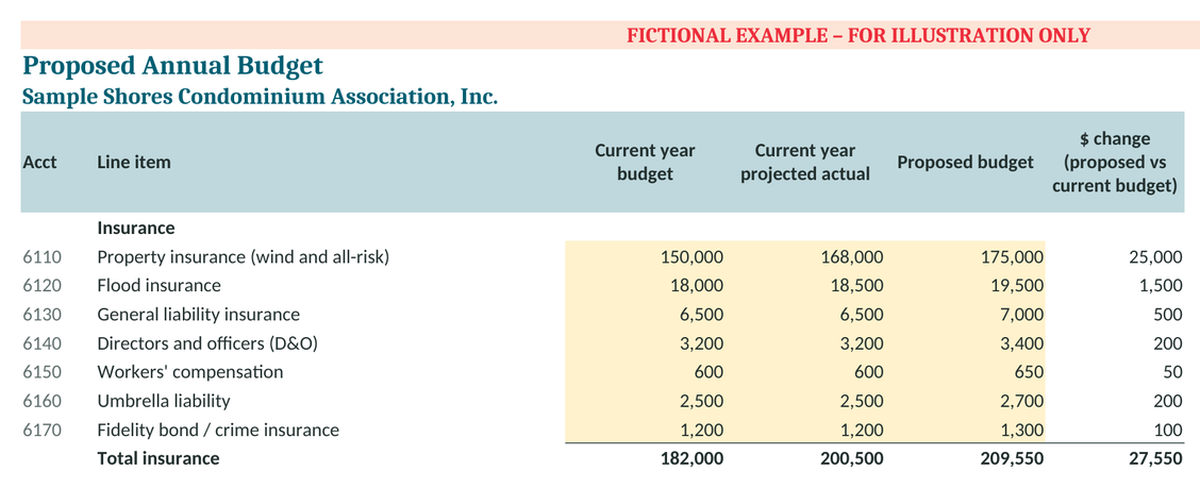
You can follow along with the completed Sample Shores budget in our free Condo Budget Template.
Watch for bills paid once or twice a year, such as insurance premiums and annual fees. They can make year-to-date figures misleading.
4. Work through the expenses line by line
Take each expense category in turn: insurance, professional services, administration, payroll, service contracts, repairs and maintenance, utilities and other operating costs. Use quotes and contracts where you have them. Where you don’t, start from the projected actual and adjust for anything you know will change.
The lines most often missed or underestimated are:
- Insurance that renews partway through the year at a higher rate.
- Annual fees, and the association’s own tax return.
- The reserve study itself, in a year when one is due.
- Repairs that are running above budget. At Sample Shores, general building repairs were budgeted at $12,000 but are running at $15,500, so next year’s figure is $14,000.
- Water and sewer increases that have already been announced.
Add a short note against every significant change. Owners will ask, and a one-line reason saves time at the meeting.
5. Be conservative with other income
Late fees, application and estoppel fees and interest on operating accounts all reduce what owners pay. But late fees only come in if owners pay late and the money is actually collected. Budget these lines low, and don’t use them to make the budget balance. If you budget too much, the year ends short.

6. Enter the reserve contributions
Reserve contributions are the amounts set aside each year for the future repair and replacement of major items. They usually come from your reserve study. At Sample Shores, next year’s contributions are $104,000 for SIRS components and $24,000 for other items.
Check that the amounts reflect your reserve study and what the association is required to fund. For SIRS items in particular, the board can’t simply decide to put in less. The figures need to be settled before the budget is finished. A blank reserve line is fine if the item genuinely doesn’t apply. It isn’t fine if the figure simply hasn’t been worked out yet. Interest earned on reserve accounts stays in the reserves, so it shouldn’t be used to lower the operating assessment.
If buyers in your building rely on mortgages backed by Fannie Mae or Freddie Mac, there is also a lender’s reserve test to check.
7. Let the assessments come out of the numbers
An association’s budget is set so that what owners pay covers the budgeted expenses. Rather than picking an assessment figure, you enter the expenses, other income and reserve contributions, and the assessments follow from them:
- Operating assessments are the total operating expenses, less other operating income.
- Reserve assessments equal the reserve contributions.
At Sample Shores, total assessments rise from $450,900 to $505,650, an increase of about 12%. Divided by 60 units and 12 months, that is an average of $702 a unit a month, up from $626.
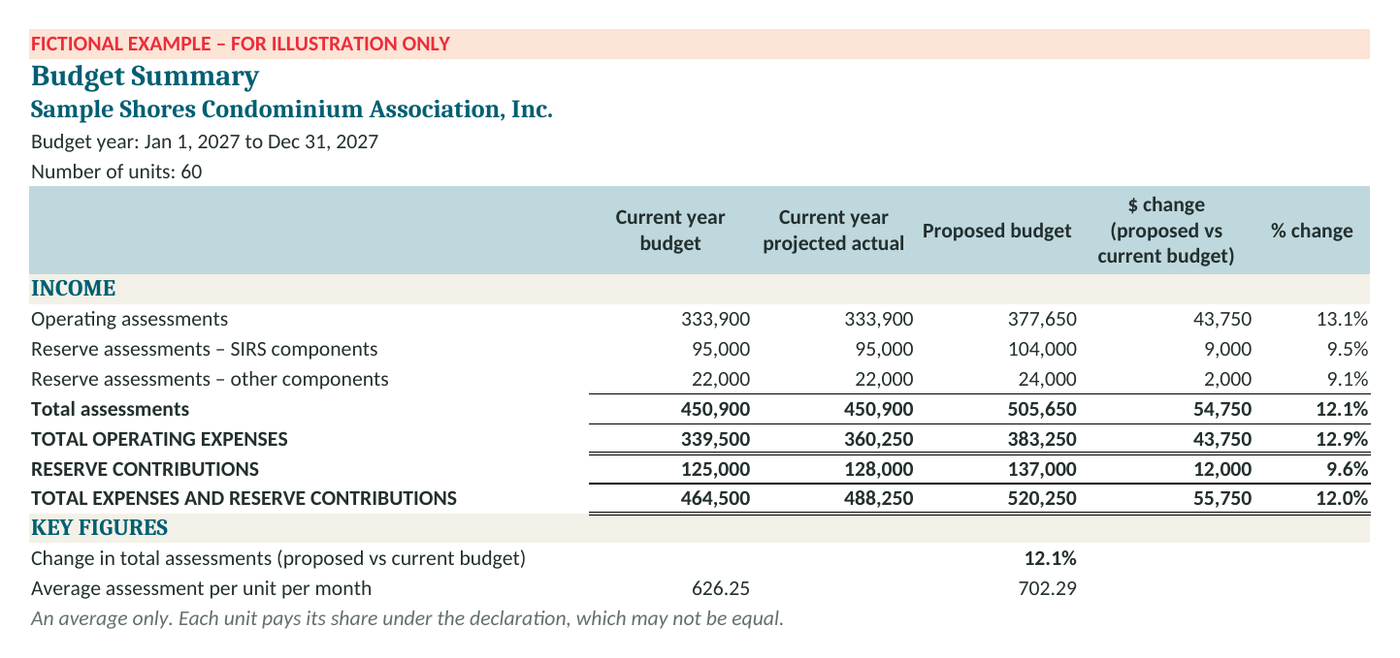
That figure is only an average. Each unit pays its share under the declaration, and in many buildings the shares aren’t equal.
8. Check it before it goes to the board
- Do the totals agree? Total income should equal total expenses plus reserve contributions.
- Does the increase make sense? Compare it with what you know about insurance, contracts and reserves.
- Is anything missing? A budget can add up and still leave out a reserve contribution or a bill that only comes once a year.
For the board, a one-page summary by category, showing this year’s budget, next year’s proposal and the change, is usually what’s needed.
Preparing the figures is only part of the job. The proposed budget then has to be sent to owners and adopted as Florida law and your governing documents require.
9. Frequently asked questions
How do you prepare a condominium association budget?
Start with this year’s adopted budget and a full-year forecast of what you’re actually spending. Work through each expense line, budget other income conservatively and enter the reserve contributions from your reserve study, and the assessments follow from those figures.
What should a Florida condominium budget include?
The association’s expected income, its operating expenses by category (insurance, professional services, administration, payroll if it employs staff, service contracts, repairs and maintenance, utilities and other costs), and its reserve contributions, including SIRS contributions if the building needs a structural integrity reserve study. Florida law and your governing documents set out what the adopted budget must show, so check them before it goes to owners.
How are condo assessments calculated?
Operating assessments are the total operating expenses less other operating income, such as late fees and interest on operating accounts. Reserve assessments equal the reserve contributions. Dividing the total assessments by the number of units and by 12 months gives an average per unit per month, but each unit pays its share under the declaration.
Can I use an Excel template to prepare my condo budget?
Yes. Our free Condo Budget Template lays out the common income and expense lines, puts this year’s budget, projected actual and next year’s proposal side by side, and works out the assessments. It comes with a step-by-step guide and a completed sample budget.

10. A good budget starts with reliable financial records
If your books can’t produce a reliable forecast for the current year, building a realistic budget is much harder. The budget is only as good as the records behind it. If the books are months behind, the bank accounts aren’t reconciled or the reports show differences no one can explain, sort that out first. At Outside Accounting, we provide bookkeeping, bank reconciliations and monthly financial reporting for Florida condominium and homeowners associations, so the board has dependable figures to plan from.
11. Try it on your own budget
Our free Condo Budget Template follows these steps. It’s an Excel workbook with a step-by-step guide and the completed Sample Shores budget, and it works out the assessments for you.
Written by Outside Accounting — specialists in financial management for Florida condominium and HOA boards. We provide clear, practical guidance to help boards stay compliant and make informed financial decisions.
Disclaimer: This article is general information, not legal, tax or reserve advice. Each association prepares and adopts its own budget under its governing documents. Sample Shores Condominium is fictional.
